The Villa at the End of the Road
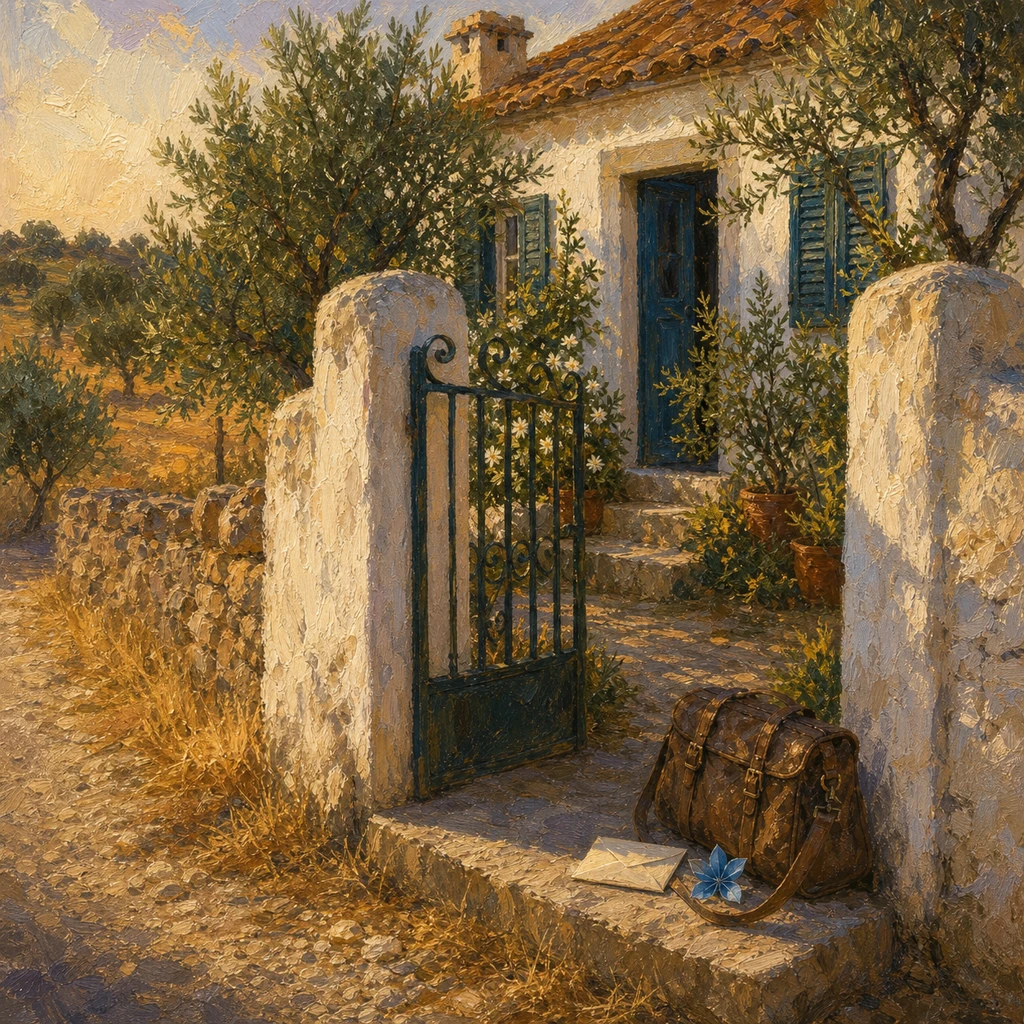
A documentary producer follows a false booking to the wrong house in rural Portugal, then finds the one thing her plans never made room for: a man patient enough to let every choice remain hers.
Slow burn romance Travel romance Vacation romance Forced proximity Small village romance
Long-form flagship 3h 13m 15 chapters


The Villa at the End of the Road is a long-form slow burn romance built around the kind of desire that has to become believable before it can become overwhelming. Isabelle is an American documentary producer in rural Portugal for Sao Joao, the midsummer village festival she has waited two years to film. She has a paid villa booking, a careful itinerary, a rental car, and the particular confidence of a woman who survives by making plans. Then the address leads her to the wrong house.
The Villa at the End of the Road
A false booking, the wrong house in rural Portugal, and a man patient enough to let every choice remain hers.
The premise
The house is real. The booking is not. Someone has used photographs of Tiago's whitewashed Alentejo home in a false listing, and by the time Isabelle verifies the scam, the festa has filled every room for miles. Tiago does not ask her to trust him. He sends her to check the real guesthouse herself. Rosa, his neighbor, finds Isabelle in the rental car after dark and gives the situation the village context Isabelle cannot yet understand: Rosa's own house is full, Tiago is known, the guest room locks, and sleeping in the car or driving ninety minutes over dark mountain roads would be worse.
That is the engine of the story. Isabelle does not stay because the plot needs proximity. She stays because every practical option has been tested, because the village vouches before desire enters the room, and because she keeps the terms clear: one night at a time, payment before sleep, her keys, her phone, her bolted door, her right to leave. The boundaries hold the whole way, and the romance grows inside them.
A flagship slow burn
Unlike Scarla's shorter three-episode stories, this is a full-length flagship told across fifteen chapters and more than three hours of audio. The pleasure is in accumulation: the first cup of coffee, the envelope on the table, Tiago translating only enough and never too much, Rosa's family dinner, the heat-storm blackout, the well pump, the moonlit water, the suitcase that keeps almost being packed. The story lets attraction become knowledge before it asks to become love.
Tiago's restraint is not distance. It is how he gives Isabelle room to decide. Isabelle's caution is not coldness. It is how she keeps herself intact after years of making fear look competent. Their intimacy works because each step still belongs to the person taking it. If you like romance tropes where forced proximity becomes emotionally intelligent instead of convenient, this is Scarla's most patient version of the form.
The world of the story
The Villa at the End of the Road is also a travel romance about being unable to consume a place from outside it. Isabelle cannot simply arrive in Portugal and have the village translate itself for her. Locals speak Portuguese first. Her translation app helps and fails. Rosa's English is warm and partial. Tiago's English is fluent because his life has passed through London and Lisbon, but he never turns that fluency into ownership of the room. The language barrier remains part of the story's texture, comic, practical, and intimate.
The setting is midsummer Alentejo: white heat, olive trees, cicadas, paper flowers from Sao Joao, village voices after dark, a market near the chapel, a public swimming hole, a kitchen table where envelopes and coffee slowly stop meaning what they meant on the first night. This is not a resort fantasy. It is a lived-in house, with tomatoes, a failing pump, neighbors who arrive without asking, and a woman discovering that a place can become real enough to make departure cost something.
Why it works in audio
A story this patient needs the ear. The sound design carries the difference between locations: birds in the olive trees, a sparse village morning, market voices, a rental car on rural roads, water opening below the road, cicadas in brutal heat, the sudden quiet after a pump finally holds pressure. The emotional turns are often small enough to disappear on a page if rushed: a chair pulled out, a phone turned face down, a gate latch, a bolt sliding home, the pause before Tiago asks a question without making it a trap.
That makes it a natural bridge between audio erotica, literary romance, and the immersive feel of spicy audiobooks. The heat is present, but the main charge is attention: two voices learning how to leave enough space for truth to arrive.
What to listen for
Listen for the ritual of the nightly envelopes, and how the meaning changes without the act disappearing. Listen for every time Tiago gives Isabelle the road back instead of standing in it. Listen for Rosa, who understands more than she translates and says the true thing before anyone else is ready. Listen for the moment the wrong house stops being a problem to solve and becomes a life Isabelle has to decide whether to revisit.
For shorter slow-burn stories, try Seven Years, One Night or The Same Table. For another immersive world with a patient romantic center, try The Cartographer of Forgotten Places.
Listen on Scarla
The Villa at the End of the Road is a long-form story on Scarla, professionally narrated with cinematic sound design across fifteen chapters. Open Scarla and start with chapter one.
Episodes
- 1
The Wrong House
Isabelle arrives in the Alentejo with a paid villa booking, a color-coded itinerary, and a plan for every hour until her flight. The address takes her to Tiago's lived-in house instead. A scam, a full village for Sao Joao, and Rosa's fierce local kindness leave Isabelle with one locked guest room, one night's payment, and the first crack in years of careful defenses.
- 2
First Light
Morning should make leaving simple. Instead, the real guesthouse is full, the festa is exactly the story she came to film, and the only workable bed is still in Tiago's house. Isabelle sets terms: one night at a time, payment before sleep, her keys, her phone, her bolted door. Staying becomes a choice she can still own.
- 3
Tomatoes
In Tiago's garden, Rosa turns tomatoes, family memory, and village English into a language Isabelle can almost follow. A cancellation opens a room ninety minutes away, clean and sensible, but taking it would cost the footage she waited two years to capture. The available escape becomes less simple than the wrong house.
- 4
Market Day
At the market near the chapel, Tiago translates without taking over. He lets Isabelle buy soap, accept jokes, and stand inside the village rather than beside it. When a charming honey seller offers wine after the music, Tiago gives her the whole sentence and the freedom to answer it, which unsettles her more than jealousy would have.
- 5
The Decision She Doesn't Make
The real Casa das Oliveiras reopens with an actual room, a correct key, and no villain left to blame. Isabelle calls staying practical: gear, interviews, batteries, translation. A call from Marta exposes the weakness in that explanation, and Tiago hears just enough to let her keep the lie if she still needs it.
- 6
The Swimming Hole
The heat turns the house into an argument, and Tiago offers public water, her car, her keys, and every exit still intact. At the swimming hole, ruined trousers, shade, and moving water bring them close enough for the choice to matter, until local teenagers arrive and make the private current public.
- 7
The Heat-Storm
A power cut brings candles, cicadas, and the kind of conversation neither of them can fold back into jokes. Tiago tells her about the marriage that ended nine years ago. Isabelle admits how much of her competence is fear with better paperwork. In the dark, the house becomes too honest to stay only shelter.
- 8
The Well
After the outage, the house loses water. Isabelle and Tiago repair the pump in the white heat, practical task by practical task, until the excuses are repaired too. Beside the old well, she finally names what she wants, and the first real kiss arrives without pretending it solves the rest of their lives.
- 9
The Days With No Plan
After the well, they do not collapse into certainty. Isabelle keeps her room, her bolt, and the nightly envelope. She kisses him in the kitchen, goes upstairs alone, then spends the next day proving she can still work without him and discovering she wants him inside the morning anyway.
- 10
At Rosa's Table
Rosa pulls them into a courtyard full of family, children, food, and Portuguese Isabelle cannot fully catch. There she sees Tiago belong: useful, teased, loved, and less lonely than he first looked. At the gate afterward, Isabelle asks him to come to town with her, not only for translation, but because she wants him there.
- 11
The Day They Did Not Plan
A quick town errand stretches into a day of cables, coffee, a restored library, and the version of Tiago that once fought for ramps and rooms people could actually use. Isabelle begins to understand what he values, and what she misses in her own life when everything works exactly as designed.
- 12
The Shape of Two
By Wednesday, the house knows their habits. They work at the same table, visit Rosa's suddenly quiet courtyard, talk about marriage, loneliness, witnesses, and choosing after the proof expires. Desire is no longer an interruption. It is becoming a shape, but the door to Isabelle's room still matters.
- 13
Moon Water
Friday night takes them back to the water under a bright moon, this time with towels, wine, and the fragile humor of two people trying not to make everything ceremonial. A ridiculous sound in the dark saves them from solemnity, and the last whole night before leaving begins to feel impossible to reduce to a plan.
- 14
What She Didn't Plan to Feel
Saturday brings check-in, a suitcase, a second-to-last envelope, and the anger that comes when love refuses to push. Tiago will not make his fear look like love. Isabelle wants to be asked and trusted at the same time. By night, tomorrow has become a door neither of them can pretend not to see.
- 15
The Last Afternoon
On Sunday, Isabelle packs for the flight herself, sets down the final envelope, and hears the question Tiago has waited to ask: will she come back. The answer does not erase the airport, the Atlantic, or the life she built. It gives the plan a new kind of honesty, and leaves the next door open.
Frequently asked questions
What is The Villa at the End of the Road about?
It is a long-form slow burn romance from Scarla about Isabelle, an American documentary producer stranded in rural Portugal by a false villa booking, and Tiago, the Portuguese man whose real house was used in the scam. Across sixteen days, one locked guest room, nightly payments, a village festa, and a Sunday flight, they move from caution to attachment without erasing Isabelle's agency.
Is this a short story or a full audiobook?
It is one of Scarla's long-form flagship stories, told across fifteen chapters with a total runtime of about three hours and thirteen minutes. It is designed for listeners who want a slower, more immersive romance rather than a quick three-episode arc.
Is it explicit?
It is intimate 18+ audio, but the focus is on slow-burn tension, emotional safety, choice, and the gradual collapse of defenses. The sensual scenes are written in a breath-and-emotion register and are grounded in consent and boundaries.
Where can I listen to it?
The Villa at the End of the Road is available in the Scarla app on Android through Google Play alongside the full catalog of professionally narrated audio stories.