The Wine Bar
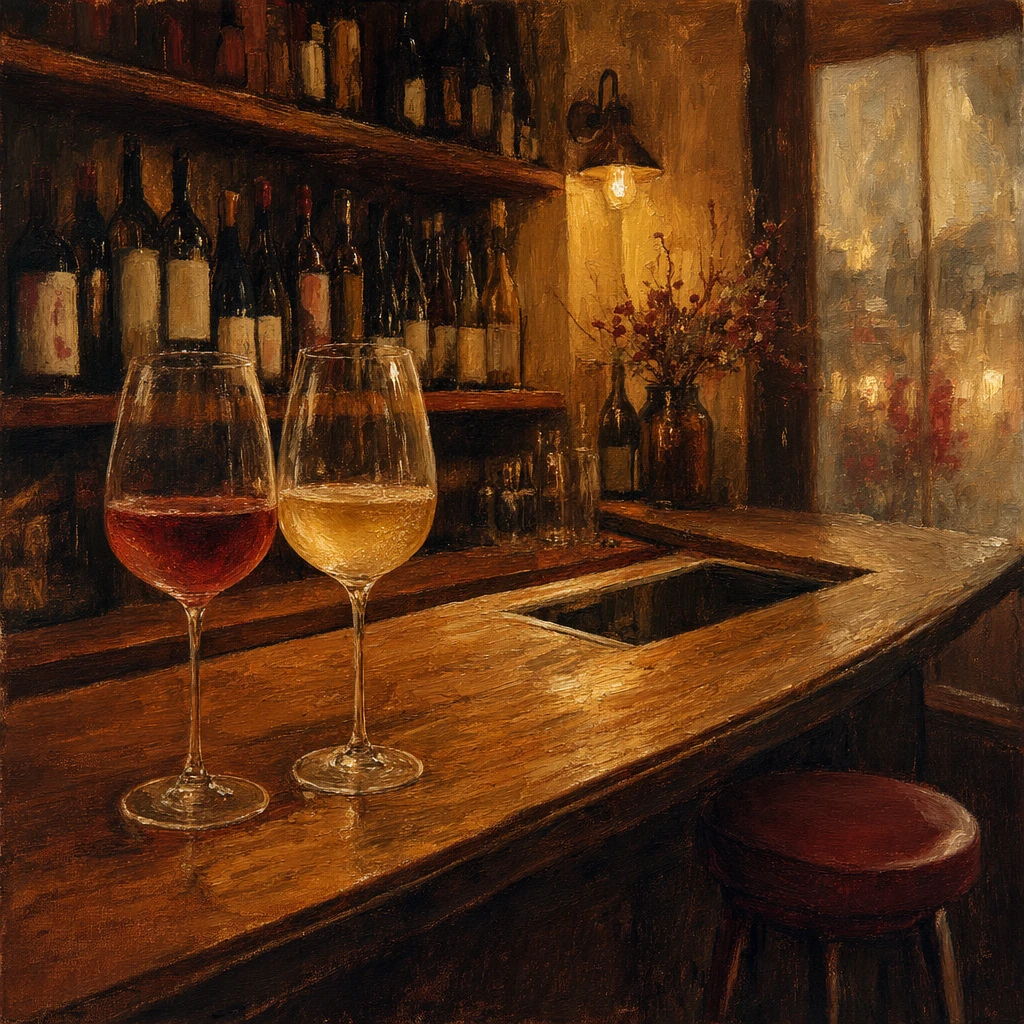
Every Tuesday for eight weeks, Estelle orders the same wine and asks Claudia what she has been thinking about. When Claudia finally answers truthfully, the natural wine bar she built as the center of her world becomes a place she can share.
Sapphic romance Lesbian romance Slow burn Bar owner Regular customer


The Wine Bar is a sapphic romance in audio about the quiet intimacy of returning. Claudia, thirty-five, built a small natural wine bar from nothing. It is the center of her world, a room designed so she can stand behind the counter and notice everything. Estelle, thirty-eight, is a Martiniquaise-French marine conservationist who has spent years leaving for remote ocean work. She comes in on a Tuesday, orders a pale Loire red, and asks Claudia what she has been thinking about that week.
Every Tuesday she orders the same wine and asks what Claudia has been thinking about.
What is The Wine Bar about?
The first visit could have remained an unusually good conversation between an owner and a customer. Instead, Estelle comes back the next Tuesday, then the next. She takes the last stool, orders the same wine, and repeats the same question. Claudia's answers grow less professional and more honest. She talks about unfinished things, loneliness, the corner she cannot see from behind the bar, and what she would do if Estelle stopped returning.
The ritual gives this slow burn romance its shape. Estelle never treats patience as a claim on Claudia. She makes room, pays attention, and lets incomplete answers remain incomplete. Claudia begins carrying the Tuesday question through the rest of her week, collecting possible answers and rejecting the ones that are not true enough. On the eighth Tuesday, after the last customers leave, she finally says the answer she has known for days: she has been thinking about Estelle.
Why is the bar central to their romance?
Claudia built the counter as a workbench, a boundary, and a way to keep everything within reach. She knows every latch and distance in the room, but she has never asked what the place might give back to her. After hours, crossing through the hinged section of the bar becomes a choice. Estelle is no longer a customer, Claudia is no longer serving, and the familiar room can hold something private without ceasing to belong to her.
The attraction is specific, warm, and reciprocal. Estelle asks before she crosses a boundary and checks when Claudia's attention turns inward. Claudia discovers that receiving is not passive: Estelle offers, Claudia answers, and each answer makes the next question possible. For listeners looking for lesbian romance built around adult communication and mutual desire, the story offers intimacy without assigning identity labels the characters never claim for themselves.
What kind of slow burn romance is it?
This is a slow burn romance built from ritual rather than delay for its own sake. Eight weeks allow Claudia and Estelle to notice each other in ordinary moments: a saved bottle, a train running late, a hidden smile, and the best stool going to whoever looks most alone. Their chemistry comes from competence and attention, with the same patient emotional focus as The Gallery Wall.
The final episode does not turn one night into instant certainty. Estelle wants a job that will not require her to disappear for months and a home she can make difficult to leave. Claudia wants dinner, Friday plans, and a future she cannot completely manage. They begin with breakfast. The bar remains the center of Claudia's world, but it no longer requires her to stand there alone.
Why does The Wine Bar work in audio?
The story's tension lives in sound: the bell at seven twelve, a cork releasing, one glass touching the wood, and the room becoming quiet after the lock turns. Professionally narrated with cinematic sound design, the repeated question changes each time Estelle asks it. The listener can hear Claudia move from a polished answer to an honest one. To understand how voice, silence, and atmosphere create that closeness, explore what audio erotica is or browse Scarla's guide to romance tropes.
Listen on Scarla
The Wine Bar is available on Scarla in three episodes. Open Scarla and begin with the first Tuesday, when Estelle chooses the last stool and asks Claudia where her mind has been.
Episodes
- 1
Tuesday
Estelle arrives alone, chooses the last stool, and asks a question no customer has asked Claudia before. Across eight Tuesdays, the same pale Loire red becomes a ritual while their answers move from the bar and fieldwork to loneliness, staying, and what Claudia would do if Estelle did not return. At last call on the eighth week, Claudia stops preparing a careful answer and tells the truth.
- 2
After Hours
With the door locked and the room quiet, Claudia and Estelle name what has been building between them. Estelle asks Claudia to leave her station only if she chooses to, then waits on the customer side of the counter. One unhurried kiss becomes a mutual lesson in attention, permission, and receiving care inside the room Claudia has always given to everyone else.
- 3
Wednesday Regular
Estelle returns at nine fifty-eight with coffee and croissants. Claudia opens the final bottle from the six she bought before the bar opened, no longer to mark an accomplishment but to mark Wednesday. Over breakfast, they make a careful proposal for dinner, unpacking one box, and discovering what they are without pretending to know already. By opening time, the last stool has a new ritual.
Frequently asked questions
What is The Wine Bar about?
It is a three-episode sapphic romance from Scarla about Claudia, the thirty-five-year-old owner of a natural wine bar, and Estelle, a thirty-eight-year-old Martiniquaise-French marine conservationist. Eight Tuesday visits turn one repeated question into a patient, intimate connection.
Is The Wine Bar a lesbian romance?
The central romance is between two women, but the story does not assign either character a specific orientation label. Scarla describes it as sapphic romance, a broad term that includes lesbian romance as well as other relationships between women.
Where can I listen to The Wine Bar?
The Wine Bar is available in the Scarla app in three professionally narrated episodes with cinematic sound design. It is intended for listeners 18 and older.